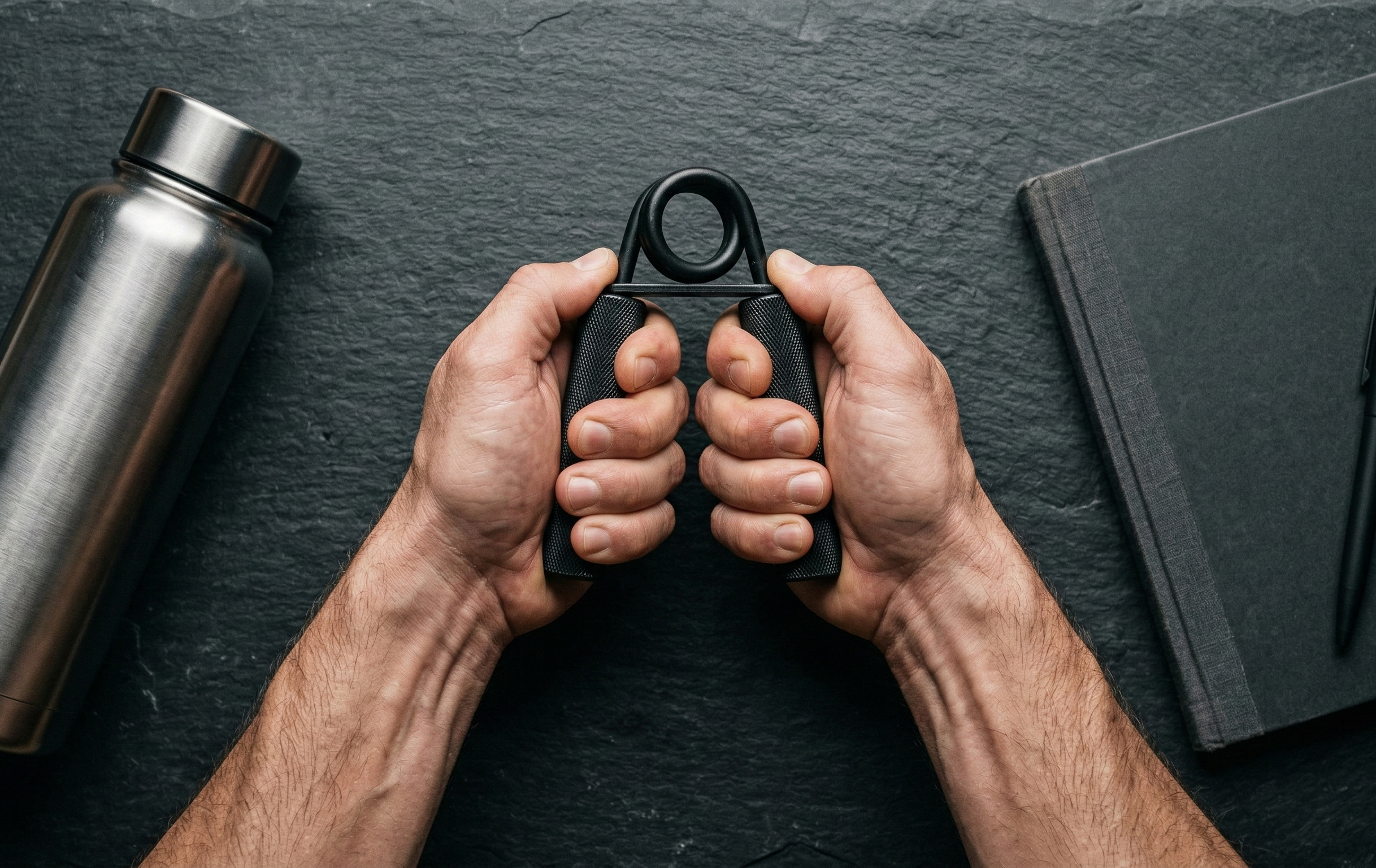
There’s a measurement your doctor almost certainly isn’t taking at your annual checkup, one that research now suggests predicts your risk of dying from cardiovascular disease better than your blood pressure does. It takes 10 seconds to measure, costs nothing to test, and can be systematically trained with tools you can buy on Amazon for under $30.
We’re talking about grip strength, and the science behind it has moved well beyond the gym.
This guide is for anyone who wants to understand why the best heavy-duty grip strengtheners belong in your longevity protocol, what the research actually says, and exactly which heavy-duty grip strengtheners are worth buying based on your specific training goal.
We also recommend checking out our guide on the Best Back Scratchers and Inversion Tables.
Table of Contents
Affiliate Disclosure: As an Amazon Associate, we may earn a commission from qualifying purchases at no additional cost to you.
The Science of Grip Strength as a Longevity Biomarker
Let’s start with the data that changed how researchers think about this.
The landmark PURE Study, the Prospective Urban Rural Epidemiology Study, enrolled over 139,000 participants across 17 countries and tracked health outcomes over four years. The study found that grip strength was inversely associated with all-cause mortality, with a hazard ratio of 1.16 per every 5 kg reduction in grip strength, and was similarly predictive for cardiovascular mortality (HR 1.17). Critically, grip strength proved to be a stronger predictor of all-cause and cardiovascular mortality than systolic blood pressure.
Read that again. Grip strength outperformed blood pressure as a mortality predictor in a study of nearly 140,000 people.
This isn’t a one-off finding. A comprehensive literature review established that grip strength consistently explains concurrent overall strength, upper limb function, bone mineral density, fractures, falls, malnutrition, cognitive impairment, depression, sleep problems, diabetes, multimorbidity, and quality of life, and provides a predictive link to all-cause and disease-specific mortality, future function, and problems associated with hospitalization.
A 2024 analysis using NHANES data (the largest ongoing U.S. health survey) further validated grip strength as a superior mortality predictor. Researchers found that after standardizing all grip strength indicators, absolute handgrip strength (HGS) and maximum grip strength (MGS) were the optimal predictors of all-cause mortality risk.
For women specifically, the numbers are stark. Women aged 40–69 with grip strength below 24.3 lbs face a 61% higher risk of breast cancer-related mortality, and men with the weakest grip strength in their late teens are 20% more likely to die by their mid-50s compared to those with moderate or strong grip strength.
The protective thresholds are also now well-characterized. Research across 28 countries found that up to a threshold of 42 kg in men and 25 kg in women, increases in handgrip strength reduce the risk of all-cause mortality, with older participants showing an inverse linear dose-response relationship.
The bottom line on the science: Grip strength is a proxy for total skeletal muscle integrity, neuromuscular function, and metabolic health. A decline in grip strength is a flag for broader issues, including muscle loss (sarcopenia), reduced neuromuscular function, and metabolic decline, and when muscle strength diminishes, physical activity declines, leading to reduced cardiovascular health, insulin resistance, and an increased risk of falls and injury.
You cannot “biohack” your way to a stronger grip with a supplement. You have to train it mechanically. That means progressive overload, the right tools, and a protocol you’ll actually stick to.
The 5 Best Heavy Duty Grip Strengtheners on Amazon
We evaluated the best heavy-duty grip strengtheners across four criteria: resistance ceiling, build quality and material durability, ergonomics for consistent training, and value for the longevity-focused buyer. These are all currently available on Amazon.
1. IronMind Captains of Crush Hand Grippers

Best For: Serious Crushing Strength & Long-Term Progression
The Captains of Crush are the gold standard of the grip training world, full stop. Built with knurled aircraft-grade billet aluminum handles that earn a 5-out-of-5 rating for durability, the Captains of Crush are available in a wide range of resistance options. The #2 grip provides 195 pounds of resistance, right in the middle of their resistance range, and has been used by Olympic-level athletes over full careers.
These are fixed-resistance tools, which means you’ll eventually need to move up a level, but that’s also what makes them the best progressive overload tool in the category. The progression ladder (from the Sport at 60 lbs all the way to the #4 at 365 lbs) gives you a clear, measurable path forward that maps directly to longevity training goals.
The handles are straight rather than contoured, which some users find takes adjustment, but the knurling ensures a non-slip grip even under high-load fatigue. Build quality is essentially indestructible.
Resistance Range: 60–365 lbs (sold individually by level) Material: Aircraft-grade billet aluminum, coil spring Best Progression Level to Start: #1 (140 lbs) for most trained individuals; Trainer (100 lbs) for those newer to dedicated grip work
2. ProsourceFit Hand Grip and Wrist Strengthener Set

Best For: Heavy Resistance Range + Value for the Dedicated Biohacker
With a robust resistance range of 100 to 350 pounds and prices ranging from $11.99 to $16.99, the ProsourceFit aluminum coil-style grippers allow you to build out a complete progressive roster without major financial investment. The ProsourceFit hand strengthener supports six different levels of resistance and is designed for heavy daily use, with knurled grips cited by users for secure handling across extended sessions.
This is the most cost-effective way to own a full resistance progression stack. For a longevity-focused buyer who wants to systematically increase load over months and years, purchasing two or three levels from this line gives you everything you need. The aluminum construction is durable, though the handles are not contoured; grip placement takes some learning.
Resistance Range: 100–350 lbs Material: Aluminum alloy handles, steel coil spring Best For: Building a full progression stack without spending $25+ per individual gripper
3. UUJOME Hand Gripper Strengthener Set (50LB–300LB, Up to 6 Pack)

Best For: Multi-Pack Training Variety & Drop-Set Protocols
The UUJOME gripper set is available in configurations from 1 to 6 pieces, covering 50LB through 300LB resistance, making it a strong option for muscle building, hand sensitivity training, and hand rehabilitation exercises.
The multi-pack format is specifically valuable for drop-set protocols, a high-stimulus training method where you begin at max resistance, complete reps to failure, then immediately drop to the next resistance level and continue. This metabolic approach accelerates hypertrophic adaptation in the forearm flexors. The set also allows bilateral training (left and right hand simultaneously), which helps identify and correct common left-to-right strength imbalances that often go unaddressed.
These use a traditional clamp design with non-slip handles. Build quality is solid for the price tier.
Resistance Range: 50–300 lbs (set-dependent) Best For: Drop-set training, bilateral programming, home gym setups
4. GD Iron Grip Hand Grip Strengthener (Adjustable, up to 198 lbs)

Best For: Adjustable Precision Training + Handle Customization
The GD Iron Grip is well-constructed from carbon steel and aluminum and offers up to 198 pounds of resistance, a figure that appears accurate and should suffice for most recreational gym-goers. It is highly adjustable, allowing modification of both resistance and handle length and spacing.
The handle length adjustment is particularly valuable for individuals with larger or smaller hands, as proper handle fit directly impacts the quality of the training stimulus. If the handles are too wide, the closing arc changes and the load shifts off the target muscles. For someone investing in grip training as a long-term longevity protocol, getting the mechanics right matters.
The trade-off with any adjustable gripper is mechanical complexity; more moving parts mean more potential failure points over time. For occasional adjustment use (not rep-by-rep changes), the GD Iron Grip holds up well.
Resistance Range: Up to 198 lbs, with incremental adjustment Material: Carbon steel + aluminum Best For: Users who need handle customization; those between fixed-resistance levels
5. Prohands Gripmaster Pro Heavy Tension (Finger-Independent Training)

Best For: Finger Isolation, Neuromuscular Precision & Cognitive-Motor Training
The Gripmaster Pro features a larger range of motion and padded finger surfaces compared to the standard Gripmaster, with independent springs per finger, allowing isolated training of each digit. The heavy tension (black) Gripmaster provides nine pounds of resistance per finger, and because each finger has its own independent spring, you can work individual fingers alongside the rest of your hand, particularly valuable when dealing with isolated finger weakness or injury.
From a longevity and neuromuscular standpoint, individual finger training has an underappreciated benefit: it targets the cortical motor representations of fine motor control, which are among the first to degrade with age-related neuromuscular decline. Maintaining precise finger strength is not just a climbing or musician’s concern; it’s a functional independence concern. Think about the daily tasks that require individual finger force: opening bottles, handling small objects, and maintaining keyboard function. Gripmaster-style training preserves this.
Resistance: 9 lbs per finger (heavy tension) Material: ABS plastic (lightweight, portable) Best For: Neuromuscular precision, finger isolation, rehabilitation protocols, travel use
Understanding Grip Strength Types: What You’re Actually Training
Not all grip training is the same, and the best biohackers are precise. Before buying a device, understand the three primary force patterns:
Crushing Grip is the closing force generated when the fingers and palm compress against resistance, like squeezing a gripper closed. This is the most studied type in longevity research and the one measured by hand dynamometers in clinical settings. Classic clamp-style grippers train this pattern.
Supporting Grip is the isometric force required to hold something under load for time; deadlifts, carries, and farmer’s walks. This is trained by thick-handle tools, towel pull-ups, and loaded carries.
Pinch Grip is the strength generated between the thumb and fingers without palm involvement. Trained by plate pinches and individual-finger devices like the Gripmaster series.
For longevity purposes, crushing grip is your primary target because it maps directly to the dynamometer measurements used in mortality research. Supporting and pinch grip are valuable complements, especially for functional independence as you age.
The formula for progressive overload in grip training mirrors any other strength domain:
Training Stimulus = Resistance × Volume × Frequency
Most people plateau because they never increase resistance. Heavy-duty grippers exist precisely to solve this problem.
The Science of Progressive Overload for Hand Strength
Your hand and forearm musculature responds to the same hypertrophic and neurological adaptation principles as any other muscle group. The primary muscles involved are the flexor digitorum superficialis, flexor digitorum profundus, flexor pollicis longus, and the intrinsic hand muscles (lumbricals and interossei). The forearm’s flexor carpi radialis and palmaris longus provide stabilizing force throughout the movement.
Mechanically, the gripper creates a rotational force at the metacarpophalangeal and interphalangeal joints. The resistance curve is non-linear; the force required increases as the gripper closes due to the spring’s compression mechanics. This means even partial reps at very high resistance provide significant stimulus.
The rate of grip strength decline with aging is well-documented. Handgrip strength declines at an annual rate of approximately 1% after midlife, and higher handgrip strength at midlife has been suggested to increase resilience to aging. Resistance training specifically targeting grip can counteract this trajectory, and the earlier you build your base, the higher your reserve.
Training prescription for longevity (not just gym performance) looks like this:
- Frequency: 3–4 days per week (grip muscles recover quickly)
- Volume: 3–5 sets of 6–15 reps per session, or 10–30 seconds of isometric holds at 80%+ of max resistance
- Progression: Increase resistance every 2–4 weeks; track reps and partial close depth
- Recovery: 48 hours between high-intensity sessions; avoid training immediately before heavy pulling work
Research shows that resistance training or muscle-strengthening activities for 30–60 minutes weekly reduces the risk of all-cause mortality, cardiovascular disease, and cancer by 10–17%. Grip training, integrated into a broader resistance protocol, is part of that calculation.
Grip Strength Maintenance Protocols for Longevity
Buying a gripper is the easy part. The protocol is where results happen. Here are three evidence-informed training templates organized by goal:
Protocol 1: The Longevity Minimum (Beginner / Time-Limited)
This protocol takes under 10 minutes and can be done anywhere: at a desk, watching TV, or during a commute.
- Tool: ProsourceFit 100 lb or UUJOME 50–100 lb
- Session Structure: 3 sets × 10 full closes per hand, 60 seconds rest between sets
- Frequency: 3× per week
- Progression Trigger: When you can complete 15 clean reps with full closure, move up one resistance level
- Goal: Maintain grip strength above the mortality-risk thresholds (42 kg / 92.5 lbs for men; 25 kg / 55 lbs for women)
Protocol 2: Progressive Strength Builder (Intermediate)
- Tool: Captains of Crush or GD Iron Grip
- Session Structure: 5 sets – 2 warm-up sets at 60% effort, 3 working sets at 85–100% effort; include both full closes and negatives (slowly resist the gripper opening for 3–5 seconds)
- Frequency: 4× per week; do not train the same day as heavy deadlifts or rows
- Progression Trigger: Move up one CoC level once you can close the current level for 10+ clean reps across all 3 working sets
- Accessory Work: Add 3×30-second farmer’s carries at bodyweight (each hand) twice per week
Protocol 3: Neuromotor & Finger Isolation (Advanced / Longevity + Function Focus)
- Tools: Gripmaster Pro for finger isolation + CoC or ProsourceFit for crushing
- Session Structure: 10 minutes Gripmaster (4 sets per finger, each hand) followed by 3 working sets of heavy crusher
- Frequency: 4× per week
- Goal: Maintain bilateral symmetry (test both hands on the same dynamometer periodically; asymmetry >10% is worth addressing), and preserve fine motor dexterity alongside max force
Tracking: Grip strength testing identifies functional decline caused by advancing muscle atrophy. For high-risk patients or serious longevity trackers, a hand dynamometer for regular at-home monitoring is increasingly recommended. Consider adding a digital hand dynamometer (readily available on Amazon for $30–$50) to your protocol twice per year for objective tracking against the clinical thresholds.
Common Mistakes That Stall Grip Training Progress
Training at the same resistance indefinitely. The most common error. Once you can close a gripper for 12+ reps, you are no longer in a hypertrophic range. The entire point of heavy-duty grippers is to force you out of your comfort zone.
Neglecting the eccentric (opening) phase. Most people squeeze and release rapidly. Slowing the eccentric, resisting the gripper as it opens, dramatically increases stimulus and reduces injury risk by strengthening the antagonist extensors.
Ignoring bilateral asymmetry. Most people’s dominant hand is significantly stronger. If you only train bilaterally (both hands equal volume), the weaker hand never fully catches up. Implement extra sets on your non-dominant side.
Training too close to heavy pulling work. Pre-fatigued forearm flexors compromise your deadlift, row, and pull-up performance. Schedule grip-specific training either on dedicated days or after your main pulling session — never before.
Choosing a starting resistance based on ego. Buying a 300-pound gripper when you can barely close a 150-pounder is ego-shopping; most manufacturers provide starting guidelines, and progressive overload is key. Start at a level where you can achieve 6–8 clean, full closures. That is your working weight.
Final Recommendation: Exactly What to Buy Based on Your Needs
If you want one tool and a clear progression path, start with the IronMind Captains of Crush Trainer (100 lbs) or #1 (140 lbs), depending on your current strength. These are the benchmark tools of grip training, built to last decades, and their resistance levels map directly to the research thresholds that matter for longevity. When you close them cleanly, you buy the next level up. It’s that simple.
If you want maximum value and a full progression stack, buy two or three levels of the ProsourceFit gripper set. At under $17 per unit, you can own the equivalent of a full CoC-style progression for roughly the cost of a single CoC gripper.
If you’re dealing with finger weakness, asymmetry, or want to target neuromotor precision, add the Prohands Gripmaster Pro to whichever crusher you choose. It takes 10 minutes, it travels anywhere, and it trains the motor patterns that most grip tools completely ignore.
If you need adjustability: The GD Iron Grip is the best adjustable option in this category, with accurate resistance numbers, solid construction, and handle customization that matters if your hands are significantly larger or smaller than average.
The non-negotiable: Whatever you buy, track your numbers, progress deliberately, and measure your grip strength against clinical benchmarks at least twice per year. Grip strength is not just a fitness metric. At this point in the literature, it is a vital sign, one you can directly, measurably improve.
Was this article helpful? Read one of these next:


Leave a Reply