If you want to know how long you’re likely to live, look at your VO2 Max. This metric measures the maximum amount of oxygen your body can utilize during intense exercise. In the longevity community, a high VO2 Max isn’t just for marathon runners; it’s a “biological insurance policy” against frailty and chronic disease.
But here is the catch: VO2 Max is an estimate based on heart rate. If your heart rate data is wrong, your VO2 Max score is fiction. In 2026, the debate isn’t just about which of the best VO2 Max trackers are prettier; it’s about the technical battle between the convenience of Wrist-Based Optical Sensors and the clinical accuracy of Chest Strap Electrocardiograms (ECG).
We also recommend checking out our guide on the Best Plants for Home Oxygen Optimization.
Table of Contents
Affiliate Disclosure: As an Amazon Associate, we may earn a commission from qualifying purchases at no additional cost to you.
The Science: The Gold Standard vs. The Consumer Lab
The “Gold Standard” of the best VO2 Max trackers is a metabolic cart test involving a mask and a treadmill. Since most of us can’t do that weekly, we rely on indirect calorimetry, algorithms that look at the relationship between your pace/power and your heart rate.
- Optical Heart Rate (Watches): Uses LEDs to measure blood flow through your skin (PPG). It’s convenient but prone to “cadence lock” and lag during high-intensity intervals.
- Electrical Heart Rate (Chest Straps): Measures the actual electrical signals of your heart (ECG). This is near-clinical grade and captures the rapid spikes and drops in heart rate that occur during Zone 5 training.
- The Algorithm Advantage: Companies like Garmin and Firstbeat use years of physiological data to turn these heart rate signals into a VO2 Max score that is now within 5% accuracy of a lab test when paired with the right sensors.
Detailed Reviews: The Best VO2 Max Trackers of 2026
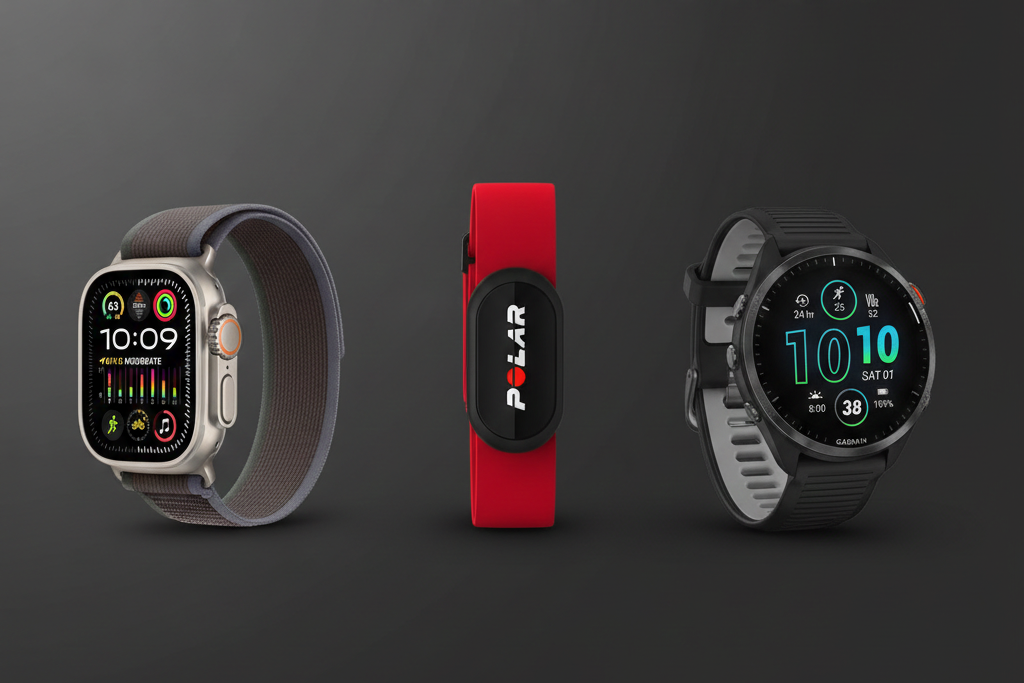
1. The Longevity Powerhouse: Garmin Forerunner 965

The Garmin Forerunner 965 is the most sophisticated tool for tracking the “Centenarian Decathlon.” It doesn’t just give you a VO2 Max number; it tells you your “Fitness Age” and how your training load is impacting your score.
- The Benefit: It features a stunning AMOLED display and the most advanced recovery metrics in the industry. It accounts for heat and altitude acclimation, ensuring your VO2 Max estimate remains accurate even in changing environments.
- Best For: Data-driven athletes who want an all-in-one wearable that manages their entire longevity protocol.
2. The Clinical Standard: Polar H10 Heart Rate Monitor

The Polar H10 remains the gold standard for accuracy in 2026. If you are serious about your Zone 5 intervals, the workouts that actually move the needle on VO2 Max, you need the ECG-level precision that only the best VO2 Max trackers can provide.
- The Benefit: It is widely used by researchers and professional athletes because it is immune to the “motion artifacts” that can throw off wrist-based sensors. It syncs perfectly with your Garmin or Apple Watch to provide the “clean” data the algorithms need.
- Best For: Anyone performing high-intensity intervals who wants to ensure their heart rate data is 100% accurate.
3. The Integrated Ecosystem: Apple Watch Ultra 2

For those already deep in the Apple Health ecosystem, the Apple Watch Ultra 2 offers surprisingly accurate VO2 Max (Cardio Fitness) tracking.
- The Benefit: Apple’s “Cardio Fitness” metric is validated against clinical data and is particularly good at tracking trends over years. The Ultra 2’s dual-frequency GPS ensures that your “pace” data is pinpoint accurate, which is the other half of the VO2 Max equation.
- Best For: Users who want a seamless blend of top-tier health tracking and everyday smartwatch functionality.
The HRV Connection: Why VO2 Max Needs Context
In 2026, we don’t look at VO2 Max in a vacuum. To understand your true “readiness” to perform a Zone 5 workout, the kind that actually moves the needle on your aerobic capacity, you must track your Heart Rate Variability (HRV) with one of the best VO2 Max trackers.
- The Recovery Link: VO2 Max tells you the size of your engine, but HRV tells you if that engine is “overheated.” If your HRV is significantly below your baseline, attempting a high-intensity VO2 Max interval session can actually be counterproductive, leading to systemic inflammation rather than adaptation.
- The “Smart” Integration: The best VO2 Max trackers, like the Garmin Forerunner 965, automatically correlate your overnight HRV with your VO2 Max trends. This creates a “Training Readiness” score that tells you exactly when to push for a new Personal Best and when to opt for a recovery walk with your weighted vest.
- Data Precision: While watches can estimate HRV, the R-R intervals (the exact time between heartbeats) are captured most accurately by a chest strap like the Polar H10. This data is the “raw fuel” for the most accurate longevity algorithms.
The Algorithm Gap: Garmin vs. Apple vs. Polar
Not all of the best VO2 Max trackers’ estimates are created equal. In 2026, the software will be just as important as the sensors. Each brand uses a proprietary “black box” to turn your heart rate and pace into a fitness score.
- Garmin (Firstbeat Analytics): Widely considered the gold standard for consumer athletes. Garmin’s algorithm accounts for External Load (like hills and wind) and Heat/Altitude Acclimation. If you’re rucking in the Florida heat, Garmin knows your higher heart rate is due to temperature, not a drop in fitness.
- Apple (Cardio Fitness): Apple uses a massive database of clinical gait and heart rate data to estimate “Cardio Fitness.” It is exceptionally consistent for steady-state walking and running, but often lags behind Garmin when it comes to capturing the nuances of anaerobic “burst” training.
- Polar: Polar focuses heavily on Running Index, which combines your VO2 Max with your running economy. It’s less about a single number and more about how efficiently your body uses oxygen at specific speeds—a vital metric for long-term “engine efficiency.”
Critical Section: Why You Must Pair Your Watch with a Strap
While modern watches like the Forerunner 965 are incredible, their wrist sensors can struggle during heavy arm movements or in cold weather (when blood flow to the skin decreases).
For the most accurate of the best VO2 Max trackers, we recommend the Hybrid Protocol: Wear your watch for 24/7 recovery and sleep tracking, but always pair it with a Polar H10 or Garmin HRM-Pro Plus during your actual workouts. This “cleans” the data and ensures your longevity progress is based on truth, not optical noise.
The VO2 Max Protocol: Moving the Needle
To actually improve your score, you need a mix of two types of training:
- Zone 2 (80% of Volume): Long, easy sessions where you can still hold a conversation. This builds mitochondrial density.
- The Norwegian 4×4 (20% of Volume): 4 minutes of high intensity (90% Max HR) followed by 3 minutes of active recovery. Repeat 4 times. This is the “hammer” that forces your VO2 Max to climb.
Conclusion: Measuring Your Aerobic Future
In 2026, VO2 Max is no longer a metric reserved for elite athletes; it is a vital sign for every longevity seeker. By investing in high-precision tools like the Garmin Forerunner 965 and pairing it with the clinical accuracy of the Polar H10, you are taking ownership of the most important metric for your future healthspan.
Was this article helpful? Read one of these next:


Leave a Reply