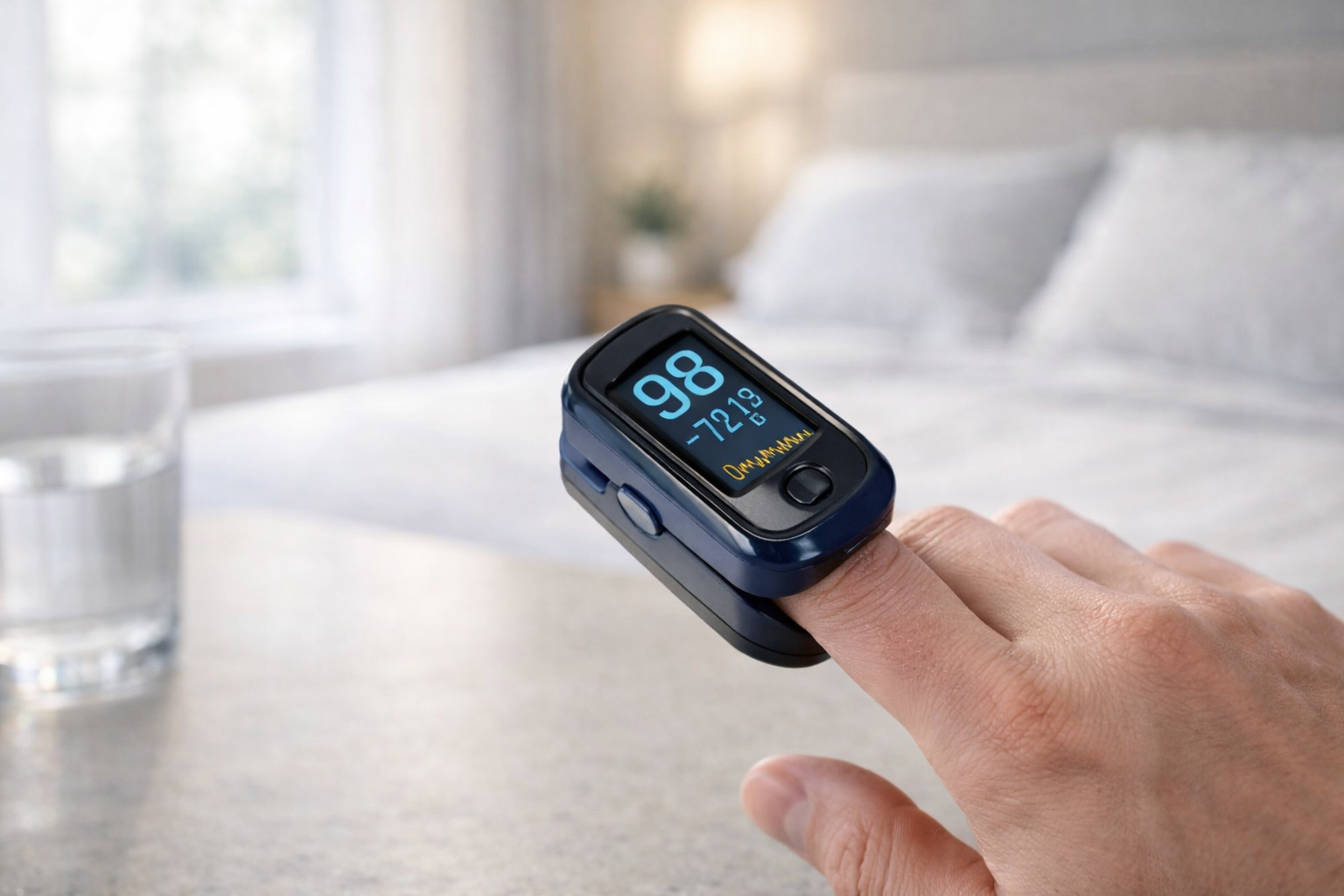
Oxygen is the most fundamental input your body uses, and one of the least monitored.
We track calories.
We track steps.
We track heart rate variability.
But oxygen saturation? Most people only think about it when they’re sick.
For those of us focused on longevity and resilience, that’s a missed opportunity.
Blood oxygen levels reflect how efficiently your lungs, cardiovascular system, and mitochondria are doing their jobs. Subtle changes can signal poor sleep, incomplete recovery, inflammation, altitude stress, or emerging illness, sometimes before symptoms are obvious.
The best fingertip pulse oximeters are one of the simplest tools you can own. They cost less than a night out, require no subscription, and give you real physiological data in seconds.
The question isn’t whether they work.
It’s which ones are accurate, and how to use them intelligently.
We also recommend checking out our guide on How to Accurately Predict Viral Load with Oura Ring.
Table of Contents
Affiliate Disclosure: As an Amazon Associate, we may earn a commission from qualifying purchases at no additional cost to you.
What Does a Pulse Oximeter Actually Measure?
A fingertip pulse oximeter measures:
- SpO₂ (oxygen saturation percentage)
- Pulse rate (beats per minute)
SpO₂ reflects how much oxygen your hemoglobin is carrying relative to its capacity.
Healthy range for most adults at sea level:
95–100%
At higher altitudes, slightly lower values are normal.
How Fingertip Pulse Oximeters Work
Inside the device are two LEDs:
- One emits red light
- One emits infrared light
Oxygenated and deoxygenated hemoglobin absorb these wavelengths differently.
The best fingertip pulse oximeters measure light absorption changes with each heartbeat and calculate oxygen saturation using a ratio algorithm.
The result is displayed as:
- SpO₂ percentage
- Pulse rate
It’s non-invasive and painless.
How Accurate Are the Best Fingertip Pulse Oximeters?
Most FDA-cleared devices have:
±2% accuracy between 70–100% saturation
That means:
If your reading says 96%, your true oxygen level is likely between 94–98%.
Accuracy depends on:
- Finger temperature
- Nail polish
- Movement
- Poor circulation
- Low battery
They are excellent trend trackers, not emergency diagnostic tools.
Best Fingertip Pulse Oximeters (2026)
1. Zacurate Pro Series 500DL Fingertip Pulse Oximeter

Best Overall for Accuracy and Value
- Clear OLED display
- Reliable readings
- Fast results
- Lightweight
Best for:
✔ General home monitoring
✔ Respiratory tracking
✔ Most users
2. Innovo Deluxe iP900AP Fingertip Pulse Oximeter

Best Premium Display & Features
- Plethysmograph waveform
- Perfusion index display
- Adjustable brightness
Best for:
✔ Data-focused users
✔ Biohackers
✔ More detailed tracking
3. Vibeat Fingertip Pulse Oximeter

Best Budget Option
- Affordable
- Compact
- Easy to use
Best for:
✔ Occasional use
✔ Backup device
4. Wellue Fingertip Pulse Oximeter

Best for Sleep & Extended Monitoring
- Data storage
- Strong signal stability
- Good build quality
Best for:
✔ Nighttime checks
✔ Recovery monitoring
Who Should Consider Using One?
The best fingertip pulse oximeters are helpful for:
- Monitoring respiratory illness recovery
- High-altitude travel
- Sleep apnea tracking (screening only)
- Athletes training at altitude
- Biohackers tracking nighttime oxygen
They are not a substitute for professional medical care.
If readings are persistently below 90%, seek medical evaluation.
Oxygen Saturation, Mitochondria, and Longevity
Most people look at SpO₂ as a “sick or not sick” metric.
Biohackers see something else.
Oxygen saturation directly influences mitochondrial ATP production, and mitochondria are central to aging.
Inside your cells, oxygen is the final electron acceptor in the electron transport chain. Without sufficient oxygen delivery, oxidative phosphorylation slows, and ATP production declines.
When oxygen availability drops, the body shifts toward:
- Increased glycolysis
- Higher lactate production
- Reduced cellular efficiency
- Increased oxidative stress in certain contexts
While brief hypoxic stress (like altitude training) can stimulate adaptation, chronic mild hypoxia is associated with:
- Endothelial dysfunction
- Impaired cognitive clarity
- Increased cardiovascular strain
- Reduced recovery capacity
For longevity-minded individuals, the best fingertip pulse oximeters serve as a baseline calibration tool.
Questions worth asking:
- Is my nighttime oxygen dipping?
- Does my oxygen drop at altitude more than expected?
- Does intense training temporarily reduce my saturation?
- Is my baseline lower than optimal?
Even a consistent reading of 94% instead of 98% may indicate:
- Suboptimal ventilation
- Undiagnosed sleep-disordered breathing
- Reduced pulmonary efficiency
- Chronic inflammation
We’re not chasing perfection. We’re looking for patterns.
Oxygen delivery efficiency is foundational to cellular resilience.
And resilience is the core of longevity.
Pulse Oximeters, HRV, and Autonomic Nervous System Regulation
The best fingertip pulse oximeters measure oxygen saturation, but they also measure pulse rate.
That matters.
Your resting pulse reflects the autonomic nervous system balance between:
- Sympathetic (fight-or-flight)
- Parasympathetic (rest-and-digest)
For recovery and longevity, parasympathetic dominance during rest is ideal.
Here’s where oxygen monitoring becomes interesting:
If oxygen saturation drops at night, the body compensates by:
- Increasing heart rate
- Increasing sympathetic activation
- Disrupting sleep architecture
This is why individuals with undiagnosed sleep apnea often show:
- Elevated nighttime pulse
- Reduced HRV
- Fragmented sleep
A fingertip pulse oximeter used occasionally during nighttime checks can reveal:
- Oxygen drops during REM
- Elevated resting pulse unexpectedly
- Poor recovery after illness
While it’s not a continuous HRV monitor, it gives you directional data.
In the biohacking world, small signals matter.
An unexplained rise in resting pulse combined with lower SpO₂ may indicate:
- Overtraining
- Illness onset
- Inflammation
- Sleep disruption
When layered with:
- HRV tracking
- Subjective recovery
- Sleep quality
You start to build a much more intelligent health picture.
Hypoxia, Altitude, and Strategic Stress for Adaptation
Here’s where it gets nuanced.
Not all drops in oxygen are bad.
Strategic hypoxic exposure (like altitude training or breathwork) can stimulate adaptation through activation of Hypoxia-Inducible Factor 1-alpha (HIF-1α).
HIF-1α activation can promote:
- Increased red blood cell production
- Improved oxygen transport capacity
- Enhanced mitochondrial efficiency
- Angiogenesis (new capillary growth)
This is one reason altitude training is used in elite sports.
However, the line between adaptive stress and chronic strain is thin.
The best fingertip pulse oximeters allow you to:
- Monitor safe ranges during breathwork
- Track acclimatization at altitude
- Observe recovery after hypoxic stress
For example:
At 7,000 – 8,000 feet elevation, healthy individuals may see resting SpO₂ in the low 90s initially. Over days, that number often rises as adaptation occurs.
Without monitoring, you’re guessing.
With monitoring, you can see:
- Whether adaptation is occurring
- Whether oxygen remains too low
- Whether symptoms correlate with saturation
For longevity-focused individuals, controlled stress is powerful.
Uncontrolled stress is damaging.
Data allows distinction.
How to Get the Most Accurate Reading
- Sit still
- Warm your hands
- Remove nail polish
- Wait 10–15 seconds for a stable reading
- Compare trends over time
Do not rely on a single quick reading.
FAQ
Are fingertip pulse oximeters accurate?
Yes, most are within ±2% accuracy in normal ranges.
Can a pulse oximeter detect COVID or pneumonia?
No. It measures oxygen saturation only.
What is a dangerous oxygen level?
Below 90% warrants medical evaluation.
Was this article helpful? Read one of these next:


Leave a Reply