In the world of biohacking, we often obsess over the “loud” metrics: our VO2 max, our bench press, or our fasting blood glucose. But in 2026, the longevity community has rallied around a “quiet” foundation that determines whether those other metrics even matter: stability training for longevity.
As Dr. Peter Attia famously notes in Outlive, stability is the cornerstone upon which all other physical pillars, strength, aerobic efficiency, and anaerobic performance, rely. Without stability, strength is a liability. It is the difference between a high-performance engine in a sturdy chassis and one bolted to a frame made of glass.
If you are training for the “Centenarian Decathlon,” the ability to be physically capable at age 100, stability is the insurance policy that prevents a fall from becoming a life-altering injury.
We also recommend checking out our guide to Urolitin A: The Mitophagy Supplement You Haven’t Heard of Yet.
Table of Contents
Affiliate Disclosure: As an Amazon Associate, we may earn a commission from qualifying purchases at no additional cost to you.
What is Stability Training for Longevity? (It’s Not Just Balance)
Most people confuse stability with “not falling over.” In a longevity context, stability is the ability to safely transmit force from one part of the body to another without losing control or causing injury.
It involves a complex communication between your nervous system and your musculoskeletal system. True stability requires:
- Intra-abdominal Pressure: The “internal weight belt” created by your diaphragm.
- Joint Centration: Keeping your joints in their most efficient, strongest position during movement.
- Foot-to-Brain Connectivity: Your feet are your only point of contact with the earth; if they are “blind,” your stability is compromised.
The Stability Protocol: 3 Essential Zones
1. The Foot & Ankle (The Foundation)
Your feet contain 26 bones and over 100 muscles, yet most of us “cast” them in stiff shoes all day. For longevity, foot strength is a primary predictor of balance.
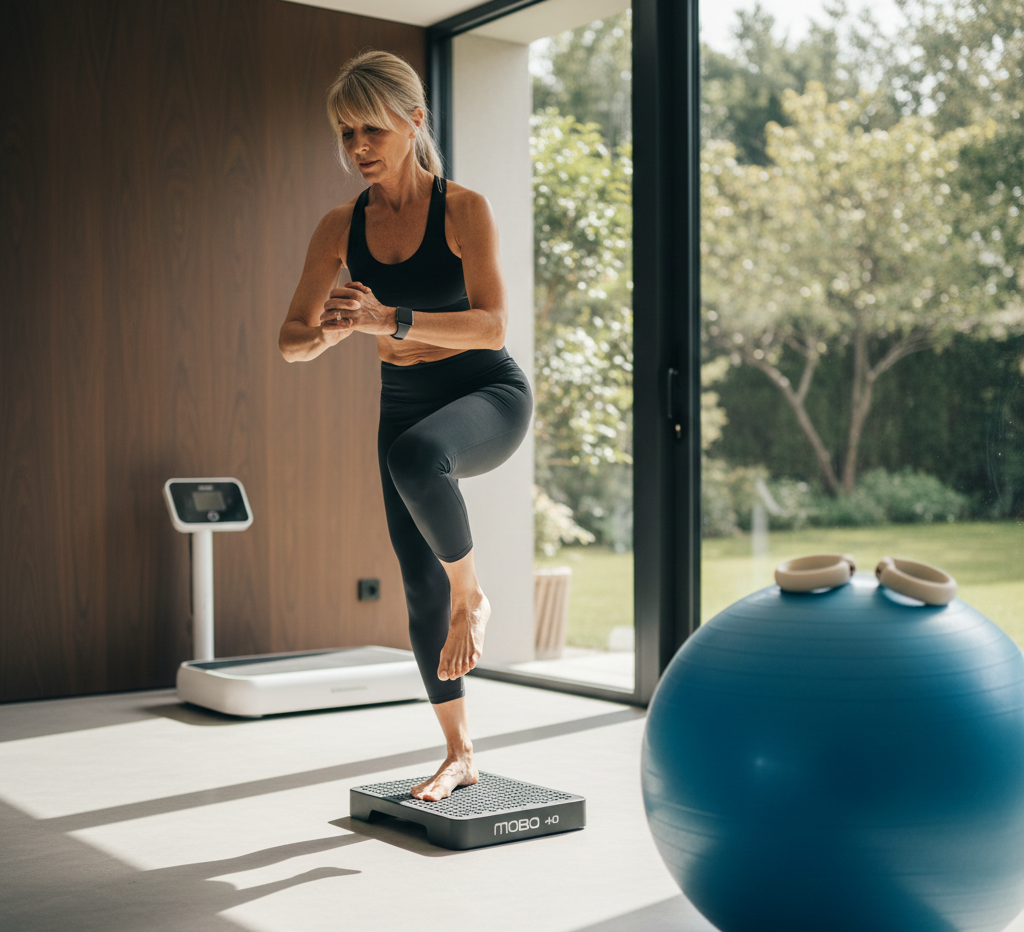
Recommended Gear: MOBO Board Stability Trainer

The MOBO Board is the 2026 favorite for “toe yoga” and arch activation. Unlike flat balance boards, it has a hollow space for your outer toes, forcing your big toe to engage and drive stability through the arch.
The Protocol: 5 minutes of single-leg stands on the MOBO board, 3x per week.
2. The Core & Spine (The Chassis)
We aren’t talking about “six-pack abs.” We are talking about the deep stabilizing muscles like the multifidus and transverse abdominis. In 2026, the trend has moved toward Dynamic Neuromuscular Stabilization (DNS), retraining your body to move with the efficiency of a healthy infant.
Recommended Gear: TheraBand Pro Series Stability Ball

A high-quality, anti-burst stability ball is the simplest tool for “active sitting” and core engagement. By replacing your office chair for just 30 minutes a day, you force micro-adjustments in your spine that build “postural endurance.”
3. Proprioception & Recovery (The Software)
Proprioception is your brain’s ability to know where your limbs are in space. As we age, this “software” glitches.
Recommended Gear: Bala Bangles Weighted Wrist & Ankle Weights

These days, we use “micro-loading” to improve stability. Adding just 1–2 lbs to your limbs during a walk or a yoga flow changes your center of gravity, forcing your brain to “re-map” your balance in real-time.
The 2026 “Centenarian Decathlon” Stability Test
Can you perform these three movements? If not, your risk of injury during strength training is significantly higher.
- Single-Leg Stand: Can you stand on one leg for 30 seconds with your eyes closed?
- The Dead Bug: Can you move your arms and legs independently while keeping your lower back pressed flat against the floor?
- Toe Yoga: Can you lift your big toe while keeping your other four toes on the ground?
Advanced Biohacking: Vibration Plates for Stability
If you want to fast-track your stability training for longevity, Whole Body Vibration (WBV) is the shortcut. Standing on a vibration plate while performing basic movements increases “motor unit recruitment,” essentially forcing your muscles to contract dozens of times per second to keep you stable.
Recommended Gear: The LifePro Rumblex 4D

The Rumblex 4D is the gold standard for home labs. It offers three distinct motors to simulate a wide range of stability challenges.
Conclusion: Stability Training for Longevity is the Seatbelt of Strength
You wouldn’t drive a race car without a seatbelt, and you shouldn’t pursue heavy strength training or high-intensity cardio without a foundation of stability. By dedicating just 10 minutes a day to foot strength, core centration, and proprioceptive drills, you aren’t just preventing falls, you are ensuring that your body remains a “high-performance machine” well into your marginal decades.
Was this article helpful? Read one of these next:


Leave a Reply