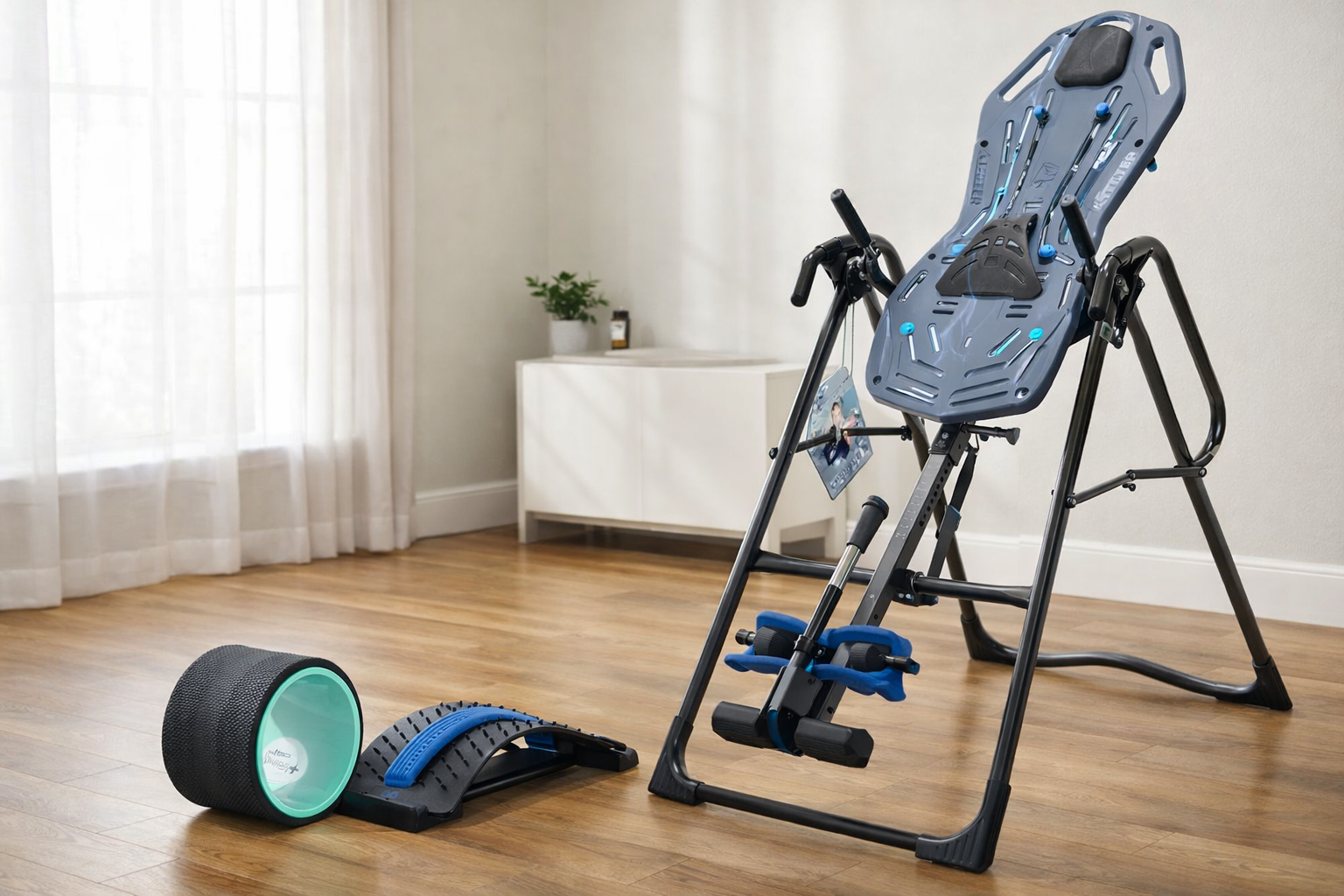
Most back pain isn’t just “tight muscles.” It’s compression.
We spend hours sitting. We bend forward constantly. Gravity loads the spine all day long. Over time, that pressure builds in the discs and joints of the lower back.
That’s why many people feel:
- Stiff when they wake up
- Achy after sitting
- Tight after long drives
- Relief when they hang from a pull-up bar
The best back stretchers and inversion tables aim to reduce that compression. But they work very differently, and one may be much better for your specific situation.
Let’s walk through what actually matters.
We also recommend checking out our guide on the Best Balance Boards for Longevity.
Table of Contents
Affiliate Disclosure: As an Amazon Associate, we may earn a commission from qualifying purchases at no additional cost to you.
Why Spinal Decompression Helps
Between each vertebra sits a disc that acts like a cushion. These discs don’t have a direct blood supply. They rely on movement and pressure changes to stay healthy.
When you’re constantly compressed:
- Fluid leaves the disc
- Mobility decreases
- Nerves can become irritated
- Muscles tighten to protect the area
When you temporarily reduce that compression, several things happen:
- Pressure eases off irritated nerves
- Muscles relax
- Joint movement improves
- You often feel taller and looser
That’s the goal of the best back stretchers and inversion tables.
The difference is how much decompression they create.
Inversion Tables: Maximum Decompression
Inversion tables use gravity.
When you tilt backward, your body weight creates traction along the spine. Instead of compressing downward, your weight gently pulls the spine in the opposite direction.
The deeper the angle, the stronger the traction.
What It Feels Like
Most people report:
- Immediate pressure relief
- A sense of “space” in the lower back
- Reduced sciatic tension
- Improved flexibility afterward
For people with disc-related pain or nerve irritation, inversion often provides stronger relief than simple stretching.
When It Makes the Most Sense
Inversion tables are ideal for:
- Chronic lower back compression
- Sciatica
- Herniated discs (with medical clearance)
- People who want the strongest decompression stimulus
When You Should Be Cautious
Because you’re going upside down, inversion temporarily increases pressure in the head.
Avoid it if you have:
- Uncontrolled high blood pressure
- Glaucoma
- Retinal issues
- Recent stroke
- Serious cardiovascular conditions
For everyone else, short sessions (2–5 minutes) are typically well tolerated.
Back Stretchers: Gentle, Daily Relief
Back stretchers are much simpler.
They’re curved devices you lie on to restore the natural arch of your lower back.
Instead of traction, they:
- Encourage proper lumbar curve
- Counteract hours of sitting
- Reduce stiffness
- Improve posture awareness
They don’t create powerful decompression like inversion tables — but they’re easier to use daily.
For many desk workers, that’s enough.
The Real Question: Which of the Best Back Stretchers and Inversion Tables Do You Actually Need?
If your pain feels deep, nerve-related, or disc-driven, inversion tables tend to provide stronger relief.
If your issue is stiffness from sitting and posture, back stretchers are usually sufficient and safer for daily use.
Best Back Stretchers and Inversion Tables (2026)
1. Teeter FitSpine X3 Inversion Table

Best Overall for Serious Back Pain
Why it stands out:
- Smooth, controlled rotation
- Adjustable inversion angles
- Extremely secure ankle system
- High build quality
If you’re investing in long-term spinal decompression, this is the most refined option.
Best for:
✔ Herniated discs
✔ Sciatic nerve pain
✔ Chronic lumbar compression
2. Innova ITX9600 Heavy Duty Inversion Table

Best Budget Inversion Table
- Sturdy steel frame
- Adjustable headrest
- Strong value for the price
It doesn’t feel as premium as the Teeter, but it gets the job done.
Best for:
✔ First-time inversion users
✔ Budget buyers
3. Everlasting Comfort Back Stretcher

Best Premium Back Stretcher
- Excellent ergonomic curve
- Durable build
- Comfortable padding
More supportive than cheap plastic stretchers.
Best for:
✔ Daily posture correction
✔ Gentle decompression
4. Chirp Wheel+

Best for Upper Back & Thoracic Tightness
Available in multiple sizes for targeted pressure.
Best for:
✔ Rounded shoulders
✔ Upper back tension
✔ Active recovery
5. Magic Back Support Back Stretcher

Best Budget Back Stretcher
- Adjustable arch levels
- Portable
- Affordable
Not as durable, but effective for light use.
Best for:
✔ Beginners
✔ Travel
The Hidden Cause of Back Pain Most People Miss: Flexion Dominance
Most of us live in spinal flexion.
- Sitting = flexion
- Driving = flexion
- Looking at a phone = flexion
- Typing = flexion
Over time, your body adapts to that position. The tissues in the front of the body shorten. The tissues in the back overstretch. The lower back often loses its natural curve.
This pattern is called flexion dominance, and it’s one of the biggest drivers of chronic stiffness.
When you’re constantly flexed forward:
- The posterior portion of the discs experience more stress
- The small joints in the spine (facet joints) stop moving through the full range
- The deep stabilizers become inhibited
- The brain begins to treat extension as “threatening.”
That’s why simply trying to “stretch your hamstrings” often doesn’t fix back pain.
Why Extension-Based Tools Help
Both the best back stretchers and inversion tables introduce the opposite stimulus: extension and decompression.
That does a few important things:
- Reintroduces spinal movement in the opposite direction
- Temporarily reduces disc pressure
- Signals to the nervous system that the spine is safe to move
For desk workers especially, this mechanical reset can feel dramatic.
The key is consistency. One session helps. Repeated exposure retrains the system.
Comparison Table: The Best Back Stretchers and Inversion Tables
| Product | Type | Intensity | Best For | Price Tier |
|---|---|---|---|---|
| Teeter FitSpine X3 | Inversion | High | Disc & nerve pain | Premium |
| Innova ITX9600 | Inversion | High | Budget decompression | Mid |
| Everlasting Comfort | Arch stretcher | Moderate | Posture correction | Premium |
| Chirp Wheel+ | Mobility wheel | Targeted | Upper back | Mid |
| Magic Back Support | Arch stretcher | Light | Entry-level use | Budget |
How to Use Them Safely
Inversion Tables
- Start at a shallow angle
- 1–2 minutes initially
- Gradually build to 3–5 minutes
- Come up slowly
Back Stretchers
- 5–10 minutes
- Slow breathing
- Relax the lower back
- Daily use is fine
Final Recommendation: What Should You Buy?
If your back pain feels structural, deep, or nerve-related:
→ Teeter FitSpine X3
If you want decompression but need to save money:
→ Innova ITX9600
If your issue is stiffness from sitting:
→ Everlasting Comfort
If you want something inexpensive and portable:
→ Magic Back Support
If upper back rounding is your main issue:
→ Chirp Wheel+
For powerful decompression, inversion tables win.
For daily consistency and posture correction, back stretchers are often easier to stick with.
FAQ
Do inversion tables permanently fix back pain?
No. They provide temporary decompression. Long-term improvement requires strength and mobility work.
Can I use a back stretcher every day?
Yes, most people can, as long as pain does not worsen.
How quickly will I notice relief?
Many people feel immediate looseness. Structural improvements take weeks.
Was this article helpful? Read one of these next:
Leave a Reply