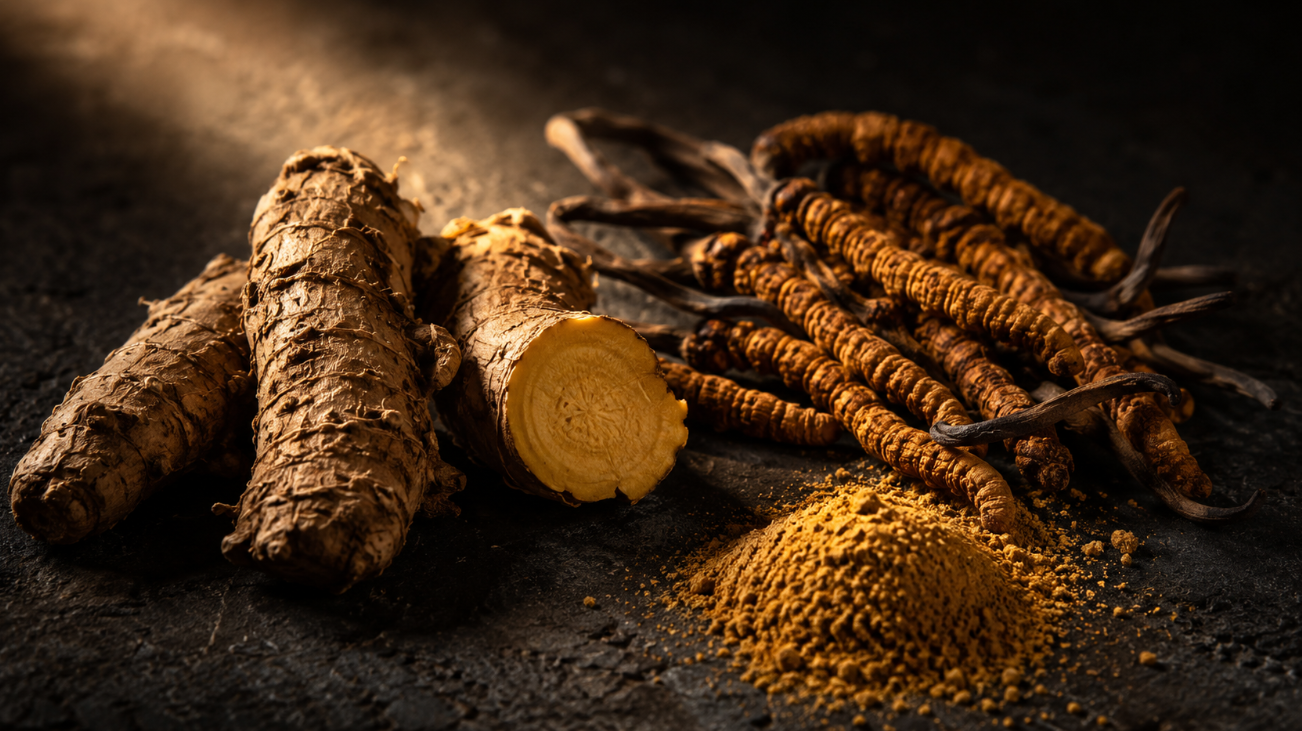
Walk into any wellness store, and you’ll find a wall of products labeled “adaptogen” with vague promises about energy, stress, and vitality. Most of that language is marketing noise sitting on top of genuinely interesting biology. Two adaptogens in particular, rhodiola rosea and cordyceps militaris, have accumulated something the broader category mostly lacks: human clinical trial data showing measurable, specific effects on mitochondrial function and oxygen utilization, the exact cellular machinery that determines how much usable energy your body can generate.
This matters more than it might first appear. Every hallmark of biological aging eventually intersects with mitochondrial decline. Mitochondria are the organelles inside nearly every cell responsible for converting nutrients and oxygen into ATP, the molecular currency your cells spend on everything from muscle contraction to DNA repair to neurotransmitter synthesis. As mitochondrial density and efficiency decline with age, a process well documented across muscle, brain, and cardiac tissue, the downstream consequences touch nearly every system in the body: fatigue, reduced exercise capacity, slower recovery, cognitive fog, and an accelerated aging trajectory.
Adaptogens occupy a useful niche in addressing this decline because, unlike stimulants that force energy output by overriding the nervous system, true adaptogens work by improving the underlying cellular machinery’s capacity to handle stress and produce energy efficiently. This guide walks through the mechanistic science behind the most evidence-backed mitochondrial adaptogens, what the human trials actually show, and which supplements are worth your consideration.
Table of Contents
The Wellness Review participates in the Amazon Associates program. If you purchase through our links, we may earn a commission at no additional cost to you. All product recommendations are editorially independent and evidence-based.
What Makes Something an Adaptogen, and Why Mitochondria Are the Common Thread
The term adaptogen was coined by Soviet pharmacologist Nikolai Lazarev in 1947 to describe a class of substances that increase the body’s resistance to a broad range of stressors, whether physical, chemical, or biological, without disrupting normal physiological function. To formally qualify as an adaptogen, a substance needs to demonstrate three properties: it must be non-specific (helping the body resist multiple types of stress rather than one narrow pathway), it must promote homeostasis (helping the body return to balance rather than pushing it in one direction), and it must be essentially non-toxic at normal doses.
What modern research has revealed is that many of the most well-studied adaptogens converge on a remarkably consistent mechanism at the cellular level: they support mitochondrial function under stress. This is not a coincidence. The stress response itself, whether triggered by exercise, cold exposure, sleep deprivation, or psychological pressure, places acute demands on cellular energy production. Compounds that help mitochondria respond more efficiently to that demand produce the broad-spectrum resilience that defines an adaptogen.
The two adaptogens with the strongest and most specific human evidence for mitochondrial and oxygen-utilization effects are rhodiola rosea and cordyceps militaris. Several others, including schisandra chinensis, panax ginseng, and ashwagandha, contribute complementary mechanisms worth understanding as part of a complete mitochondrial resilience protocol.
Rhodiola Rosea: The Most Mechanistically Documented Mitochondrial Adaptogen
Rhodiola rosea, also called golden root or arctic root, grows in cold mountainous regions across Europe and Asia and has been used in traditional Scandinavian and Russian medicine for centuries to combat fatigue and improve resilience to harsh climates. The modern research on rhodiola has progressed well beyond traditional use claims into specific mechanistic and clinical territory.
The foundational human trial, conducted by Spasov and colleagues, administered 50 mg of rhodiola daily to 40 medical students over 20 days during a high-stress academic period. The students receiving rhodiola showed statistically significant improvements in physical fitness, neuromotor coordination, and mental performance, alongside reduced mental fatigue, improved sleep quality, and greater mood stability compared to placebo. This is a clean demonstration of the broad-spectrum stress resilience that defines adaptogen activity, but the more recent research has gotten specific about why.
A study examining rhodiola’s effect on mitochondrial ATP content found that supplementation better preserved mitochondrial ATP levels following intense exercise compared to controls. The mechanism appears to work partly through salidroside, one of rhodiola’s primary bioactive compounds, which has been shown in skeletal muscle cell research to activate AMP-activated protein kinase (AMPK), often described as the master regulator of cellular energy metabolism. AMPK activation triggers a cascade of downstream effects that improve how cells manage energy during periods of metabolic stress, including enhanced glucose uptake, improved fat oxidation, and increased mitochondrial biogenesis, the process by which cells produce new mitochondria.
A 2024 study using primary human myoblasts (immature muscle cells) found that a controlled-cultivation rhodiola extract modulated the expression of transcription factors involved in muscle differentiation and recovery, while simultaneously promoting reactive oxygen species scavenging, ATP production, and mitochondrial respiration directly in human muscle tissue. This is meaningfully different from animal or rodent data: it demonstrates the mitochondrial mechanism operating in actual human cells.
The exercise performance literature consistently shows rhodiola supporting endurance capacity through what researchers describe as an anti-fatigue mechanism tied to improved cellular bioenergetics rather than a stimulant effect. Athletes supplementing with rhodiola show reduced post-exercise lactate dehydrogenase and creatine kinase, markers of exercise-induced muscle damage, alongside the preserved mitochondrial ATP content noted above.
Cordyceps Militaris: The Oxygen Utilization Specialist
Cordyceps occupies a different but complementary niche in the mitochondrial adaptogen category, with its strongest evidence centered on oxygen delivery and utilization rather than direct ATP preservation.
A comprehensive 2024 narrative review examined five intervention studies involving 321 participants and found consistent evidence that cordyceps militaris supplementation improves indices of aerobic performance and exercise capacity, including maximal oxygen uptake (VO2max), time to exhaustion, and maintenance of peripheral oxygen saturation during high-intensity exercise.
The most compelling individual study in this body of evidence involved healthy older adults in a double-blind, placebo-controlled trial of Cs-4 (a fermentation product of cordyceps sinensis used in much of the older clinical literature). After six weeks of supplementation at 3 grams per day, VO2max increased significantly in the treatment group, from 1.88 to 2.00 liters per minute, while the placebo group showed no change. The ventilatory threshold, the point at which the body shifts toward less efficient anaerobic metabolism during exercise, also improved significantly in the treatment group. This is a clean, randomized, placebo-controlled demonstration of a measurable physiological effect on aerobic capacity in an older population, precisely the demographic where declining mitochondrial efficiency and oxygen utilization matter most for longevity.
A separate 2024 study examined a mushroom blend containing cordyceps militaris in younger, recreationally active adults. After three weeks of 4 grams daily, VO2max improved significantly in the treatment group by 4.8 ml/kg/min, compared to a negligible 0.9 ml/kg/min change in the placebo. Time to exhaustion improved significantly at both the one-week and three-week marks. The proposed mechanism involves enhanced vasodilation and improved metabolic efficiency that together increase oxygen delivery to working tissue, alongside an interesting finding of increased red blood cell size, which may improve the oxygen-carrying capacity of blood itself.
Animal research has identified a specific mitochondrial mechanism behind these human performance findings. A randomized, placebo-controlled study in mice found that Cordyceps militaris improved endurance capacity and reduced markers of fatigue, specifically by promoting mitochondrial biogenesis, the same new-mitochondria-creation process that rhodiola’s salidroside compound triggers through AMPK activation. Two different adaptogens, two distinct bioactive compound pathways, converging on the same fundamental mitochondrial outcome.
It’s worth noting that the cordyceps evidence is not uniformly positive. A study in highly trained male cyclists found no significant improvement in VO2 peak or time trial performance after five weeks of supplementation, suggesting that already highly trained athletes with maximized aerobic capacity may see smaller or negligible benefits compared to recreationally active adults or older populations with more room for improvement. This is a meaningful and honest caveat: Cordyceps appears most beneficial for those starting from a baseline of suboptimal mitochondrial efficiency, which describes most adults pursuing longevity optimization rather than elite athletes already near their physiological ceiling.
Schisandra Chinensis: The Mitochondrial Protector
Schisandra berry, used in traditional Chinese medicine for centuries, contributes a complementary mechanism to the mitochondrial resilience picture: protection rather than direct stimulation.
Schisandra’s primary bioactive compounds, a class called lignans (including schisandrin and gomisin compounds), have demonstrated hepatoprotective and broader cytoprotective effects that extend specifically to mitochondrial membranes. Research has documented that schisandra lignans improve physical work capacity while protecting mitochondria from oxidative damage during periods of metabolic stress, functioning as both an antioxidant defense system and a mild adaptogenic stimulant.
This protective mechanism is mechanistically distinct from the AMPK-mediated mitochondrial biogenesis pathway of rhodiola and cordyceps. Where those two compounds appear to drive the creation of new, functional mitochondria and improve oxygen utilization, schisandra’s contribution is reducing the oxidative damage that degrades existing mitochondrial function over time. For a comprehensive mitochondrial resilience protocol, this protective layer complements the biogenesis-promoting effects of the other adaptogens covered here.
Panax Ginseng and the Antioxidant-Fatigue Connection
Panax ginseng’s relevance to mitochondrial resilience operates through its well-documented antioxidant capacity and its effects on fatigue in populations with elevated inflammatory burden. A 2024 study published in the Korean Journal of Internal Medicine found that Panax ginseng significantly reduced fatigue in patients with rheumatic diseases, a population characterized by chronic inflammation that places ongoing metabolic stress on mitochondrial function. Black ginseng, a processed variant, has demonstrated additional anti-fatigue properties specifically tied to increased antioxidant capacity and mitochondrial function support.
Ginseng’s ginsenoside compounds appear to support cellular energy metabolism partly through improved antioxidant enzyme activity, reducing the oxidative burden that mitochondria must contend with during periods of physical or inflammatory stress. This makes ginseng a particularly relevant addition for anyone managing chronic inflammatory conditions alongside a mitochondrial resilience protocol, complementing rather than duplicating the mechanisms of rhodiola and cordyceps.
How These Mechanisms Fit Together: A Systems View
Understanding why combining these adaptogens makes biological sense requires seeing how their distinct mechanisms address different points in the mitochondrial resilience pathway.
Mitochondrial biogenesis, the creation of new mitochondria, is driven significantly by the AMPK and PGC-1alpha signaling pathway. Rhodiola’s salidroside directly activates AMPK. Cordyceps appears to promote biogenesis through a related but distinct pathway involving improved oxygen delivery and metabolic efficiency. Both compounds are pushing the same fundamental biological lever: more and more functional mitochondria per cell.
Oxidative stress is the primary driver of mitochondrial damage over time, as the electron transport chain that produces ATP also generates reactive oxygen species as a metabolic byproduct. Schisandra’s lignan compounds and ginseng’s ginsenosides both provide antioxidant protection that reduces this ongoing damage, extending the functional lifespan of existing mitochondria while the biogenesis-promoting compounds work on creating new ones.
Oxygen delivery is the rate-limiting input for mitochondrial ATP production during physical exertion. Cordyceps’s vasodilatory and red blood cell effects directly address this delivery bottleneck, ensuring that the improved mitochondrial machinery actually receives the oxygen substrate it needs to operate at higher capacity.
This systems view explains why traditional adaptogen formulations, going back centuries before anyone understood the underlying cell biology, frequently combined rhodiola, cordyceps, schisandra, and ginseng together. The empirical wisdom of combining these specific botanicals appears to map remarkably well onto the mechanistic biology that modern research has now characterized.
What to Look for When Choosing Adaptogen Supplements
Standardization to active compounds. For rhodiola, look for standardization to at least 3% rosavins and 1% salidroside, the ratio used in most of the positive clinical research. Unstandardized rhodiola extract delivers an unpredictable and often inadequate dose of the active compounds.
Fruiting body versus mycelium for Cordyceps. This distinction matters significantly. The fruiting body is the visible mushroom structure where the concentration of beneficial compounds, including beta-glucans and cordycepin, is highest. Mycelium-based products, grown on grain substrate, are cheaper to produce but deliver substantially lower concentrations of the bioactive compounds that drove the clinical research results. Always look for “fruiting body extract” specifically on the label rather than “mycelium” or unspecified “cordyceps powder.”
Species clarity for Cordyceps. Wild cordyceps sinensis is the species used in much of the older Chinese clinical literature, but it is extraordinarily expensive and increasingly scarce due to overharvesting. Cordyceps militaris is a cultivated species that has become the standard in quality commercial supplements, and the more recent human trials (including the strongest VO2max data discussed above) have predominantly used militaris. This is a case where the more sustainable, cultivated species also happens to be the one with the most current clinical support.
Third-party testing and organic certification. Mushroom and root-based supplements are particularly susceptible to heavy metal contamination, depending on growing conditions, since fungi and roots can concentrate environmental contaminants from soil. Organic certification and published third-party heavy metal testing are meaningful quality signals in this category specifically.
Realistic dosing. The clinical research used doses considerably higher than many commercial products provide. Rhodiola trials showing meaningful effects used 50 mg to several hundred milligrams of standardized extract daily. Cordyceps trials used 1 to 4 grams daily of the active material, far more than the 500 mg to 1 gram found in many capsule products. Check labels carefully against research doses rather than assuming any product labeled with these ingredients delivers a clinically relevant amount.
The 5 Best Adaptogens for Mitochondrial Resilience
1. NOW Foods Rhodiola 500mg (Standardized 3% Rosavins, 1% Salidroside)

Best For: Research-Aligned Dose, Trusted Brand, Mitochondrial ATP Preservation
NOW Foods’ Rhodiola is standardized to exactly the 3% rosavins and 1% salidroside ratio used across the positive clinical literature, including the studies demonstrating mitochondrial ATP preservation and AMPK activation. NOW has operated as a family-owned supplement manufacturer since 1968 and holds NPA A-rated GMP certification, reflecting decades of consistent quality control. At 500mg per capsule, a single daily dose delivers a research-relevant amount of standardized extract without requiring multiple capsules to reach an effective level.
The straightforward formula contains no unnecessary additions beyond the standardized rhodiola extract itself, making it easy to dose precisely and stack with other adaptogens. Best taken on an empty stomach in the morning, as rhodiola’s mild activating effect can interfere with sleep if taken later in the day. Most users report noticeable effects on energy and stress resilience within one to two weeks, with the deeper mitochondrial biogenesis effects building over 8 to 12 weeks of consistent use.
Active Compounds: 3% rosavins, 1% salidroside (500mg)
Best For: Mitochondrial ATP preservation, stress-related fatigue, research-aligned dosing
2. Real Mushrooms Cordyceps Capsules (Fruiting Body Extract)

Best For: VO2 Max Improvement, Pure Fruiting Body, No Grain Fillers
Real Mushrooms built its entire brand reputation around a single quality principle that matters enormously for cordyceps specifically: using only fruiting body extract, never mycelium grown on grain. This distinction is the difference between a product concentrated in the bioactive compounds (cordycepin and beta-glucans) that drove the VO2max and oxygen utilization results in human trials, and a product diluted with starch from the grain substrate mycelium is grown on.
Each capsule delivers cordyceps militaris extract rich in beta-glucans, third-party tested and free of grain fillers, with a clean vegan formula. For the oxygen utilization and aerobic capacity improvements documented in the clinical trials, consistent daily use over a minimum of three to six weeks is necessary, mirroring the timeline in the research where VO2max changes emerged at the one-to-three week mark and continued building through six weeks.
Active Compounds: Cordycepin, beta-glucans (100% fruiting body extract)
Best For: VO2max improvement, oxygen utilization, exercise capacity in recreationally active or older adults
3. Gaia Herbs Cordyceps Mushroom (5x Strength, Organic Fruiting Body)

Best For: Concentrated Single-Capsule Dosing, Organic Certification, Sustainable Sourcing
Gaia Herbs’ Cordyceps Mushroom uses 100% organic cordyceps militaris fruiting body extract with no mycelium, grain, or starch fillers, concentrated to a stated 5x strength that allows a single daily capsule to deliver a meaningfully potent dose without requiring multiple capsules. For over 35 years, Gaia Herbs has operated with a soil-to-supplement quality oversight model, growing much of its raw material on its own regenerative organic certified farmland in North Carolina.
The product is gluten-free, dairy-free, soy-free, and uses cultivated cordyceps militaris rather than wild-harvested cordyceps sinensis, aligning with both sustainability and the species most directly supported by the recent VO2max and exercise capacity research discussed above. A reliable choice for anyone who wants concentrated potency in the simplest possible daily format.
Active Compounds: Cordycepin, beta-glucans (organic fruiting body extract, 5x concentration)
Best For: Concentrated single-capsule dosing, organic sourcing, daily simplicity
4. Gaia Herbs Astragalus Supreme (Schisandra Berry + Astragalus Root)

Best For: Mitochondrial Antioxidant Protection, Liver Support
For the protective layer of a mitochondrial resilience protocol, Gaia Herbs’ Astragalus Supreme combines schisandra berry with astragalus root and ligustrum in a liquid phyto-capsule formula designed for antioxidant and immune support. Schisandra’s lignan compounds, including schisandrin and gomisin, provide the cytoprotective effect on mitochondrial membranes discussed in the science section above, reducing the oxidative damage that degrades mitochondrial function over time.
This combination formula reflects the traditional Chinese medicine pairing of schisandra and astragalus, two botanicals frequently used together for broader resilience support. Well tolerated at any time of day, it pairs naturally alongside rhodiola or cordyceps as the protective complement to their biogenesis-promoting mechanisms.
Active Compounds: Schisandrin, gomisin lignans (schisandra berry), astragalus root extract
Best For: Mitochondrial protection from oxidative stress, liver support, combination protocols
5. NOW Foods Panax Ginseng (Standardized Extract)

Best For: Antioxidant Enzyme Support, Fatigue Reduction in Inflammatory Conditions
NOW Foods’ Panax Ginseng extract provides a standardized dose of ginsenosides, the bioactive compounds behind the antioxidant enzyme support and fatigue-reduction effects documented in recent clinical research, including the 2024 study showing significant fatigue reduction in patients with rheumatic diseases. For anyone managing chronic low-grade inflammation alongside a mitochondrial resilience protocol, ginseng’s antioxidant mechanism complements rather than duplicates the AMPK-driven biogenesis pathways of rhodiola and cordyceps.
Like rhodiola, ginseng has a mild activating quality best suited to morning use. NOW’s standardized extract format ensures consistent ginsenoside content from capsule to capsule, an important quality marker given the natural variability in raw ginseng root potency.
Active Compounds: Ginsenosides (standardized extract)
Best For: Chronic fatigue, inflammatory burden, antioxidant enzyme support
Comparison Table
| Product | Adaptogen | Active Compounds | Standardization | Best For |
|---|---|---|---|---|
| NOW Foods Rhodiola 500mg | Rhodiola rosea | Rosavins, salidroside | 3% / 1% | Mitochondrial ATP preservation, stress fatigue |
| Real Mushrooms Cordyceps | Cordyceps militaris | Cordycepin, beta-glucans | Fruiting body only | VO2max, oxygen utilization |
| Gaia Herbs Cordyceps | Cordyceps militaris | Cordycepin, beta-glucans | Organic, 5x strength | Concentrated single-capsule dosing |
| Gaia Herbs Astragalus Supreme | Schisandra + Astragalus | Schisandrin, gomisin | N/A | Mitochondrial antioxidant protection |
| NOW Foods Panax Ginseng | Panax ginseng | Ginsenosides | Standardized extract | Fatigue reduction, antioxidant support |
Building a Mitochondrial Resilience Protocol
Start with one compound and observe. Rhodiola or cordyceps, individually, taken consistently for six to eight weeks, gives you a clear sense of how your body responds before adding additional adaptogens to the stack. Track subjective energy, exercise capacity, and recovery time as practical markers, or use objective data like VO2max testing or HRV trends if you have access to those measurements.
Pair with the mechanisms already covered in this series. A mitochondrial adaptogen protocol works synergistically with several other interventions covered elsewhere in our longevity content. NMN supplementation restores the NAD+ substrate that mitochondrial energy metabolism depends on. Spermidine-driven autophagy clears the damaged mitochondria that accumulate with age, creating room for the new, healthy mitochondria that rhodiola and cordyceps help generate. Red light therapy at 660 and 850nm wavelengths directly stimulates mitochondrial cytochrome c oxidase activity. Together, these interventions address mitochondrial health from multiple complementary angles: restoring fuel substrate, clearing damaged units, stimulating new biogenesis, and directly activating existing function.
Timing relative to exercise. For cordyceps specifically, taking your dose 30 to 60 minutes before aerobic exercise aligns with the timeframe in which the vasodilation and oxygen utilization effects are most relevant. Rhodiola’s effects are less acutely timing-dependent and work well as a consistent morning supplement regardless of exercise timing.
Realistic expectations on timeline. The clinical research consistently shows that meaningful effects, whether on VO2max, ATP preservation, or subjective fatigue, take a minimum of one to three weeks to emerge and continue building through six to twelve weeks of consistent use. These are not acute stimulants that produce same-day effects. Patience and consistency are the actual protocol, not the dose itself.
Final Thoughts on Mitochondrial Adaptogens
What separates rhodiola and cordyceps from the broader, often poorly substantiated adaptogen category is the specificity and consistency of the human clinical evidence pointing to a defined mechanism: mitochondrial biogenesis, ATP preservation, and oxygen utilization. These are not vague energy claims. They are measurable, reproducible physiological effects documented in randomized, placebo-controlled human trials, including in older adult populations where mitochondrial decline is most clinically relevant.
For a longevity protocol built on the premise that cellular energy production underlies nearly every other marker of healthy aging, rhodiola and cordyceps represent two of the most mechanistically well-supported botanical tools available. Adding schisandra for mitochondrial protection and considering ginseng for inflammatory-related fatigue rounds out a comprehensive, evidence-based approach to supporting the cellular powerhouses that everything else in your longevity protocol ultimately depends on.
Was this article helpful? Read one of these next:


Leave a Reply