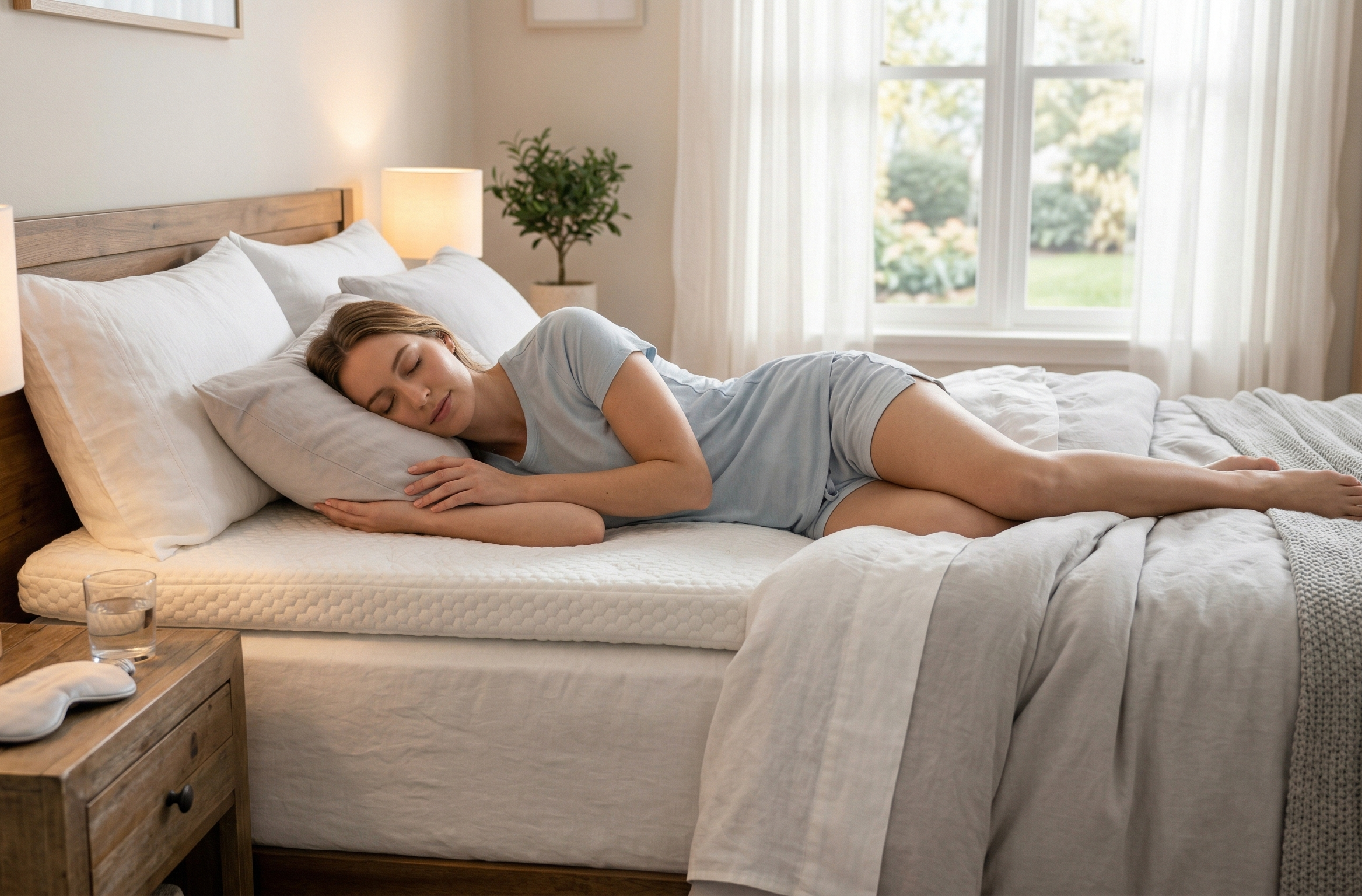
Most people chasing better sleep focus on the obvious: a consistent bedtime, limiting screen time before bed, and cutting off caffeine by 2 PM. All of that matters. But there’s one factor that quietly determines whether you actually get into deep, restorative slow-wave sleep each night, and most people never think about it.
Your body temperature.
Not the temperature of your room. Not how warm your sheets feel. The actual thermal environment right at your skin surface, the place where your body’s cooling system either gets the support it needs to do its job, or gets sabotaged by a mattress that traps heat all night.
The science here is compelling enough to have changed how seriously sleep researchers and biohackers take sleep hygiene. And the good news is that fixing it doesn’t require a $4,000 smart bed. The best cooling mattress toppers, most of which are available on Amazon for under $200, can meaningfully shift the thermal environment you sleep in every single night.
This article explains exactly what’s happening biologically, why it matters for longevity and cognitive recovery, and which toppers are actually worth buying.
We also recommend checking out our guide on the Best Grounding Sheets.
Table of Contents
TheWellnessReview.blog participates in the Amazon Associates program. If you purchase through our links, we may earn a commission at no additional cost to you. All product recommendations are editorially independent and evidence-based.
Why Temperature Is the Most Underrated Lever in Sleep Optimization
Here’s the mechanism, explained simply.
About two hours before you naturally feel sleepy, your body begins shedding heat; your core temperature starts falling, blood flows toward the surface of your skin, and that heat radiates away. This temperature drop is one of the primary signals your brain receives that it’s time to sleep. It triggers melatonin release, slows the metabolic rate, and sets the stage for the deepest, most restorative stages of sleep.
The problem is what happens next. If your sleeping surface is trapping that heat and reflecting it back at you rather than letting it dissipate, your body’s cooling process stalls. The thermal signal that keeps you in deep sleep gets disrupted. You may sleep for seven or eight hours and still wake up feeling like you barely rested, because physiologically, you weren’t getting the recovery you needed.
The research on this is quite detailed. A study published in Scientific Reports found that enhanced conductive body heat loss during sleep, essentially, a sleeping surface that actively conducts heat away from the body, increased the amount of time spent in Stage N3 (slow-wave deep sleep) by a meaningful margin and simultaneously reduced resting heart rate. The researchers described conductive body cooling as “a reliable method for promoting N3,” deep sleep, with effects that are accessible to anyone willing to adjust their sleep environment.
Slow-wave sleep is the stage where most of the biological heavy lifting happens. Growth hormone is released. Cellular repair gets underway. The brain’s glymphatic system, its waste-clearance mechanism, flushes out metabolic debris, including the amyloid proteins associated with cognitive decline. Memory consolidation locks in what you learned that day. If you’re consistently missing adequate time in this stage because your sleeping surface is keeping you too warm, the downstream effects compound over months and years in ways that matter for longevity.
The target ambient bedroom temperature, according to consistent sleep research and the National Sleep Foundation, is between 60°F and 67°F (15–19°C). But even in a properly cooled room, the immediate surface you’re sleeping on can run several degrees warmer than the ambient air if it’s made from heat-trapping materials like traditional memory foam. That’s where a cooling topper changes the equation.
The 5 Best Cooling Mattress Toppers
1. ViscoSoft Active Cooling Copper Topper (4 inch)

Best For: Hot Sleepers Who Want Maximum Passive Cooling
ViscoSoft’s Active Cooling Copper Topper is one of the most consistently top-ranked best cooling mattress toppers across independent testing organizations, and the performance data backs it up. In head-to-head thermal testing, its copper-infused foam paired with a phase-change IceSilk cover produced among the largest average bed-surface temperature drops of any non-active topper in its price range.
The construction is solid: 2 inches of copper-infused memory foam over 2 inches of copper-infused structural foam, wrapped in a cover that uses both Thermal Deflection Technology and phase-change yarns to actively manage surface temperature. The copper does two things simultaneously: it conducts heat away from your skin at the contact surface and distributes it laterally through the foam rather than letting it pool underneath you. The cover adds a layer of active management on top.
At 4 inches thick, it significantly changes the feel of your current mattress, making it a good choice for anyone whose mattress has gotten firmer with age or who wants a softer, more pressure-relieving surface alongside the cooling benefits. The 90-day return guarantee and adjustable corner straps round out a well-designed product. Consistently rated at 4.5 stars across thousands of Amazon verified reviews.
Technology: Copper-infused foam + phase-change cover
Thickness: 4 inches
Best For: Dedicated hot sleepers, those wanting cooling + pressure relief, side sleepers
2. Linenspa Gel-Infused Memory Foam Topper (2 inch)

Best For: Budget Entry Point With Real Cooling Performance
If you’re not sure whether one of the best cooling mattress toppers will make a meaningful difference for your specific sleep situation, or if budget is a primary constraint, the Linenspa Gel-Infused Topper is the most responsible recommendation at the entry-level price point. It’s been Amazon’s consistent top seller in the mattress topper category for years and holds a 4.4-star average across well over 100,000 verified reviews.
What it does well: the ventilation channels cut through the foam significantly improve airflow compared to solid foam construction, and the gel-swirl infusion keeps surface temperatures 2–3°F cooler than uninfused foam in independent trials. For a moderate hot sleeper or someone in a climate-controlled bedroom who just needs a bit more breathability, this delivers meaningful improvement.
What it doesn’t do: it won’t match the thermal performance of copper-infused or phase-change toppers for severe hot sleepers. Think of it as a solid, affordable step in the right direction rather than a maximum-output solution. At 2 inches, it also adds a gentler change to your mattress feel than the 3–4 inch options.
Technology: Gel-infused foam with ventilation channels
Thickness: 2 or 3 inch options
Best For: Moderate hot sleepers, budget-conscious buyers, first-time topper users
3. Tempur-Pedic TEMPUR-Adapt + Cooling Mattress Topper (3 inch)

Best For: Pressure Relief + All-Night Temperature Consistency
Tempur-Pedic doesn’t need much introduction in the sleep category, but what earns the TEMPUR-Adapt + Cooling its place is the combination of material science and cover technology working together. The topper is built with 3 inches of proprietary TEMPUR-ES material, a softer, more adaptive variant of the dense TEMPUR foam Tempur-Pedic is known for, which is engineered to be more breathable than standard memory foam and designed to minimize heat retention rather than trap it.
Where it really pulls ahead for temperature regulation is the cover. It’s a premium knit fabric woven with phase-change material, meaning it’s designed to feel cool to the touch every time you lie down and to actively absorb and dissipate body heat at the surface level before it accumulates in the foam. Tempur-Pedic specifies it keeps the sleep surface up to 8 degrees cooler, and unlike some cover treatments that degrade with washing, the cooling properties are built into the fiber structure and hold up through repeated laundry cycles.
Independent testing consistently ranks this as one of the best cooling mattress toppers for motion isolation alongside its cooling performance, making it a particularly strong choice for couples where one partner sleeps warmer than the other. The foam adapts precisely to body shape, weight, and temperature, reducing tossing and turning that can itself interrupt sleep cycles. Available in all standard sizes on Amazon with Prime shipping.
Technology: TEMPUR-ES memory foam + phase-change knit cover
Thickness: 3 inches
Best For: Couples, pressure relief priority, all-night temperature consistency, premium buyers
4. Saatva Natural Latex Topper (Graphite Memory Foam variant available)

Best For: Natural Material Preference + Passive Cooling Without Synthetic Infusions
Saatva sits at the premium end of what’s accessible on Amazon and offers two relevant options for different buyer profiles. Their Natural Latex Topper uses perforated Talalay latex, the most breathable foam construction available in consumer toppers, paired with an organic cotton cover. For readers who prefer natural materials and want to avoid synthetic gel and copper infusions, this is the option.
Talalay latex’s open-cell structure allows genuine airflow through the topper rather than just at the surface. In thermal camera testing by independent reviewers, perforated Talalay latex kept surface temperatures below 90°F all night, comparable to the performance of some copper-infused options through a completely different mechanism. It also provides a livelier, more responsive feel than memory foam, which some sleepers strongly prefer.
For those who want the Saatva quality but don’t have a latex preference, their Graphite Memory Foam Topper infuses traditional memory foam with graphite, a highly thermally conductive material, to achieve cooling through conductivity rather than structure. Graphite performs similarly to copper in thermal testing and is an excellent alternative for anyone who wants the deep-contouring cradling feel of memory foam alongside strong cooling performance.
Technology: Perforated Talalay latex (natural option) or graphite-infused memory foam
Thickness: 1.5–3 inches, depending on model
Best For: Natural material preference, responsive feel, and premium quality seekers
5. Slumber Cloud Performance Pad (Outlast PCM Fill)

Best For: Lightweight Cooling Layer Over an Already-Comfortable Mattress
Not every hot sleeper needs to radically change their mattress feel. Sometimes the mattress itself is comfortable, and all that’s needed is a thermal buffer at the surface. The Slumber Cloud Performance Pad solves exactly this problem. It uses Outlast phase-change material, originally developed for NASA, to regulate astronaut body temperature in a thin, lightweight pad that lies over your existing mattress without significantly altering its feel.
Rather than adding inches of foam like most of the best cooling mattress toppers, the Outlast fill absorbs excess heat as it approaches skin temperature and holds it, preventing the surface from getting warmer. When your body cools slightly during sleep, the material releases the stored heat and resets. It’s a genuinely sophisticated approach to temperature regulation without the structural changes of a full foam topper.
Good Housekeeping awarded it “Best Overall Cooling Pad” after a 67-product head-to-head evaluation. The 4.7-star Amazon average reflects a product that consistently does what it promises for the audience it’s designed for: people who sleep hot but don’t need or want a full mattress topper.
Technology: Outlast PCM fill (NASA-developed phase-change material)
Thickness: Pad, not foam, adds minimal height
Best For: Hot sleepers with an already-comfortable mattress, those who want thermal management without changing mattress feel
The Science of Sleep Thermoregulation: Your Body’s Built-In Sleep Switch
Understanding exactly how temperature and sleep interact makes it easier to appreciate why the best cooling mattress toppers make a real difference.
Your body’s thermostat lives in a region of the brain called the preoptic hypothalamus, a small but powerful structure that monitors your core temperature constantly and orchestrates the thermal changes that accompany sleep. As sleep approaches, this structure drives what’s called peripheral vasodilation: blood vessels near the skin surface dilate, allowing heat to radiate outward from your hands, feet, and face. Your core cools. Sleep follows.
This process is so fundamental that researchers describe the core body temperature drop as one of the most reliable triggers for sleep onset in mammals. It continues throughout the night: core body temperature reaches its lowest point in the early morning hours, which is also when the deepest and longest slow-wave sleep episodes occur.
Research comparing subjects sleeping in dynamic thermal environments versus constant ones found that lowering and delaying the minimum core body temperature, essentially supporting and extending the body’s natural nighttime cooling arc, produced significantly longer slow-wave sleep. The researchers concluded that using this thermal manipulation to improve overall sleep quality was a genuinely viable strategy.
Here’s the practical implication: your mattress either helps or hinders this process. Traditional memory foam, even the high-density kind found in premium mattresses, has a well-documented tendency to trap body heat and reflect it back. Sleeping on memory foam can be like sleeping on a surface that slowly gets warmer as the night progresses, working directly against your body’s biological cooling agenda.
The best cooling mattress toppers exist specifically to interrupt this dynamic. Depending on their materials and technology, they work through different mechanisms, some passively, some actively, to either conduct heat away from your body, absorb and release it at a controlled rate, or both.
The Different Types of Cooling Technology: What Actually Works
Walk into the best cooling mattress toppers category on Amazon, and you’ll encounter a lot of marketing language. “Advanced cooling.” “Ice-silk.” “Arctic gel.” Most of it is legitimate, but the technologies behind it work differently, and understanding the differences helps you match a product to your actual sleep situation.
Gel-Infused Foam is the most common and most accessible cooling technology available on the best cooling mattress toppers. Gel beads or swirls are mixed into memory foam during manufacturing. The gel has higher thermal mass than foam alone, meaning it absorbs more heat before warming up. It also distributes that heat more evenly rather than letting it concentrate under your body. Gel-infused foam will feel cooler than standard foam and perform meaningfully better for moderate hot sleepers. The honest caveat: gel infusion alone typically produces a 2–5°F surface temperature difference: real, but not dramatic.
Copper-Infused Foam takes the heat-dissipation logic a step further. Copper is one of the best thermal conductors in nature. When infused into foam, it actively pulls heat away from the contact surface and distributes it through the topper, where it can dissipate into the surrounding air. Independent testing of copper-infused toppers has found average bed-surface temperature drops in the range of 6°F compared to standard cotton-covered foam, roughly double the performance of basic gel infusion. Copper also has natural antimicrobial properties, which contribute to a cleaner sleep surface over time.
Latex is the most naturally breathable foam material and the one that needs the least engineering to sleep cool. Open-cell latex, particularly Talalay-processed latex, has an inherently porous structure that allows significant airflow through the material rather than trapping it. Perforated latex takes this further, with channels cut through the foam to increase ventilation. Latex doesn’t need copper or gel to sleep cool because its structure already permits the kind of airflow that prevents heat buildup.
Phase-Change Materials (PCMs) are arguably the most sophisticated passive cooling technology in consumer toppers. PCMs are substances engineered to absorb large amounts of heat at a specific temperature, typically around skin temperature, as they shift from solid to liquid at the molecular level. They effectively act as a thermal buffer: when your skin gets warm, the PCM absorbs the heat and changes phase, keeping the surface temperature stable. When you move or the surface cools, the PCM releases stored heat and resets. High-quality PCM covers can produce the most consistent temperature regulation throughout the night of any passive cooling technology.
Active Water-Cooling Systems (like the Chili Sleep Dock Pro or Eight Sleep) take a completely different approach. They circulate temperature-controlled water through a thin pad under your sheets, maintaining a precise, programmable temperature all night. These are in a different category in terms of cost and complexity, but they’re the only technology capable of maintaining a specific target temperature regardless of ambient room temperature or body heat output.
What to Look For When Buying: The Non-Negotiables
Here’s what separates a genuinely effective cooling topper from one that just uses the right marketing language.
CertiPUR-US Certification means the foam has been independently tested and verified to be free of harmful chemicals, including heavy metals, formaldehyde, and ozone-depleting compounds. This should be table stakes for anything you’re sleeping on for eight hours a night. Any foam topper worth buying will have it.
Thickness matters for the right reasons. A 2-inch topper will change the feel of your sleep surface moderately. A 3–4-inch topper will significantly alter it, useful if your current mattress is worn or too firm, but more of an adjustment if your mattress is already comfortable. Thicker foam also has more thermal mass to absorb heat, which can work in your favor with an actively cooled topper or against you with a basic one.
Cover technology is often underrated. The surface you actually sleep against plays a significant role in your thermal experience. Covers made from bamboo, Tencel lyocell, or phase-change yarns will perform meaningfully better than basic polyester for heat management. The best cooling mattress toppers can lower perceived surface temperature by several degrees on their own.
Density and durability correlate. Higher-density foam toppers (4–5 lb per cubic foot) last longer without developing permanent body impressions. Lower-density options (2–3 lb) are cheaper but can develop sagging within a year of regular use. For a longevity protocol where consistency matters, investing in denser foam pays off.
The Bigger Sleep Temperature Protocol: Getting More From Your Topper
Using one of the best cooling mattress toppers is one piece of a complete thermal sleep protocol. Here’s how to stack the other elements for maximum deep sleep payoff.
Set your thermostat between 65–67°F if possible. Research consistently identifies this range as the sweet spot for most adults. If your bedroom runs warmer than this, a real issue in the summer, especially, a cooling topper alone can only compensate so much. It works best in combination with a cool ambient environment.
Take a warm shower or bath 60–90 minutes before bed. This sounds counterintuitive, but it’s one of the most well-validated sleep hacks in the literature. The warm water dilates blood vessels near the skin, which accelerates heat loss when you step out. Your core cools faster, sleep onset accelerates, and early-night deep sleep deepens. This is called the warm bath effect, and the research behind it is consistent across multiple studies.
Switch to breathable bedding. The topper’s cooling performance can be partially undone by a synthetic, heat-trapping sheet on top of it. Natural fibers, cotton, linen, bamboo-derived viscose, or Tencel lyocell, allow your body’s heat to pass through rather than building up between you and the topper.
Keep your feet uncovered or lightly covered. Your feet are one of the primary heat-dissipation sites your body uses during the pre-sleep cooling process. Keeping them accessible to cooler air, or sleeping with a foot outside the sheets, actively supports the thermoregulatory process your body is trying to complete.
Track your sleep stages. If you’re already using an Oura Ring, Garmin, or Whoop, run a baseline week before adding your topper, then run a comparison week after. Look specifically at deep sleep duration and sleep onset latency. These are the metrics most directly affected by thermal optimization, and seeing them change is one of the more satisfying biohacking feedback loops available.
A Note on Active Cooling Systems
The Chili Sleep Dock Pro and similar water-cooled systems represent the top of the thermal sleep optimization market. They circulate temperature-controlled water through a thin pad, maintaining a precise, programmable sleep temperature all night with temperature swings of less than 1°F in testing. They’re also significantly more expensive, involve a bedside unit, and require some maintenance.
For most readers, the passive and phase-change options above will produce meaningful improvement at a fraction of the cost. If you’re a severe hot sleeper, a night sweater, or someone going through hormonal changes that significantly affect nighttime temperature regulation, the active systems may be worth the investment, but that’s a different article. The best cooling mattress toppers listed above represent the best of what’s available on Amazon for passive thermal management, and for the majority of people, they’re where we’d start.
Final Recommendation: Which One to Buy
If you’re a serious hot sleeper and want the highest passive cooling performance, the ViscoSoft Active Cooling Copper Topper is the best cooling mattress topper for you. The combination of copper-infused foam and a phase-change cover produces the largest and most consistent temperature drop of anything in its price range, and the 4-inch profile makes it a genuine sleep upgrade on multiple dimensions simultaneously.
If your mattress is already comfortable and you don’t want to change its feel, the Slumber Cloud Performance Pad is the cleanest of the best cooling mattress toppers. Add it, swap to breathable sheets on top, and get the thermal benefits without touching the structural characteristics of your existing sleep setup.
If budget is the primary constraint, start with the Linenspa Gel Memory Foam. It’s not the most powerful cooling solution available, but for a moderate hot sleeper in a climate-controlled bedroom, it delivers real improvement at a price that removes any reason not to try it.
The research is clear. The thermal environment is one of the most impactful variables in sleep architecture. If you’re already doing the other things right, such as a consistent schedule, a dark room, no screens, and you’re still waking up unrested, the surface you’re sleeping on is worth a serious look.
Was this article helpful? Read one of these next:


Leave a Reply